Nordic Dock: Concept Research & Moodboard Creation
I want to share something I made that was not part of my diploma brief but came directly out of it.
As part of my interior design diploma I have been working on a concept project for a fictional family — the Franklins — who have a mid-century home in Bristol. The wife has Swedish roots and loves calm neutral spaces. The husband is a keen sailor who works in eco-housing. Two kids. A home that needs to work for everyone.
The diploma work involved building a physical concept research scrapbook — gathering materials, images, found objects, paint swatches, sketches — and then developing two design concepts from that research. No interiors imagery at concept stage. Just the worlds behind the brief. Scandinavian culture, hygge, fika, the city of Bristol, sailing as a material language, mid-century architecture, sustainability.
That scrapbook work produced a concept I called Nordic Dock.
Where Nordic Dock came from
The name came out of the research itself. Concept name came from the brief of client where wife wanted Scandinavian culture and Husband is a keen sailor. Hence the name. It is not a theme. It is a feeling. A design language that could hold Eva's neutrals and Xavier's boldness in the same room without either one winning.
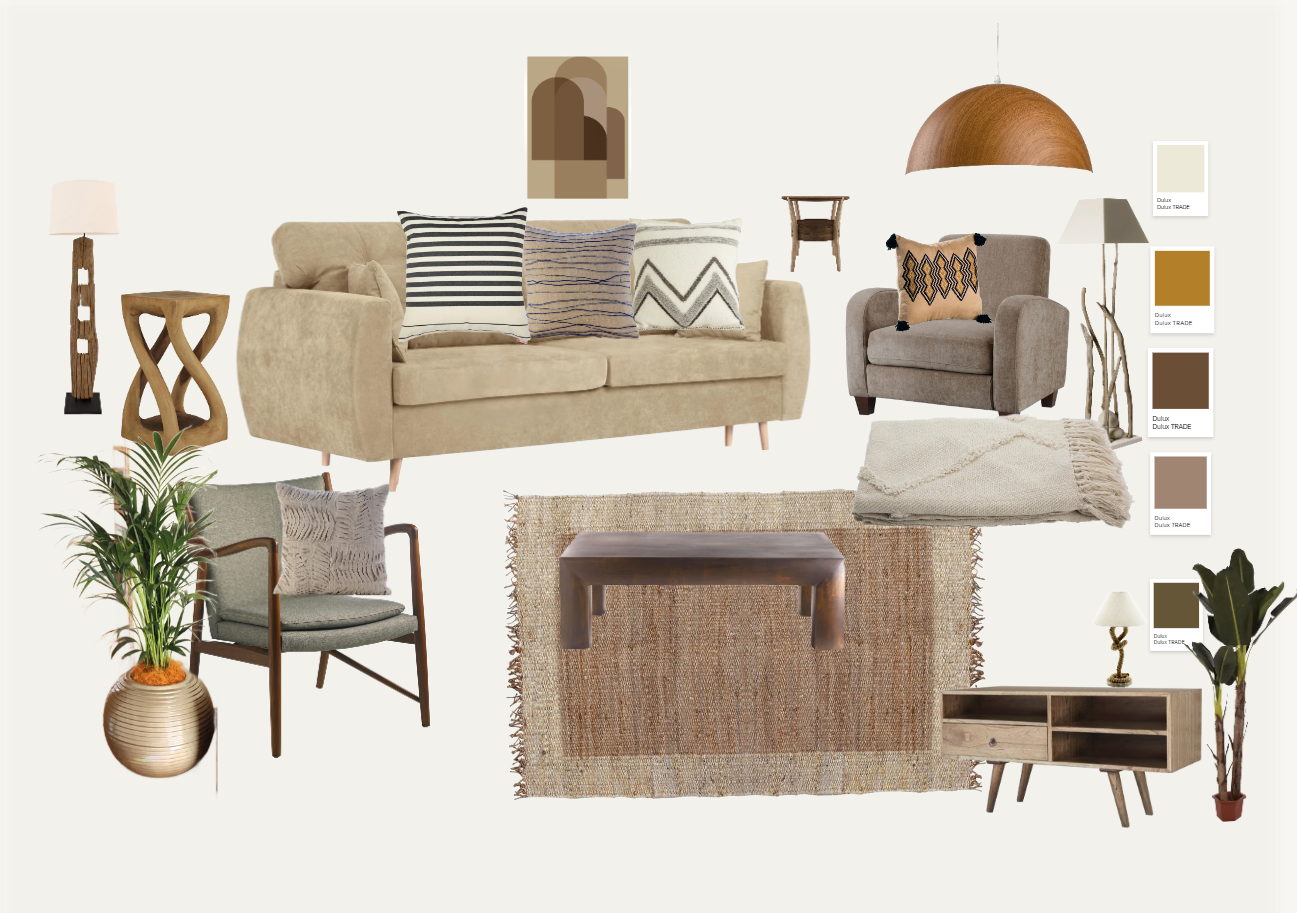
Once the diploma concept work was done I could not stop thinking about how would it actually look. So I went further — entirely off my own back — and built a moodboard on Houzz to find out.
Building the moodboard
I started with the palette. Warm neutrals as the base — linen, jute, walnut, stone. A mustard accent to give Xavier something bold without taking over the whole room.
The sofa came next — low profile, tapered legs, warm sand upholstery. Mid-century in structure, Scandinavian in restraint. The accent chair with the sculptural walnut frame is where his personality really enters the room. The jute rug, the driftwood lamp, the indoor plants bring the natural world in quietly.
The striped cushions carry the sailing reference. Present but not loud. Not a themed room.
Generating the visual
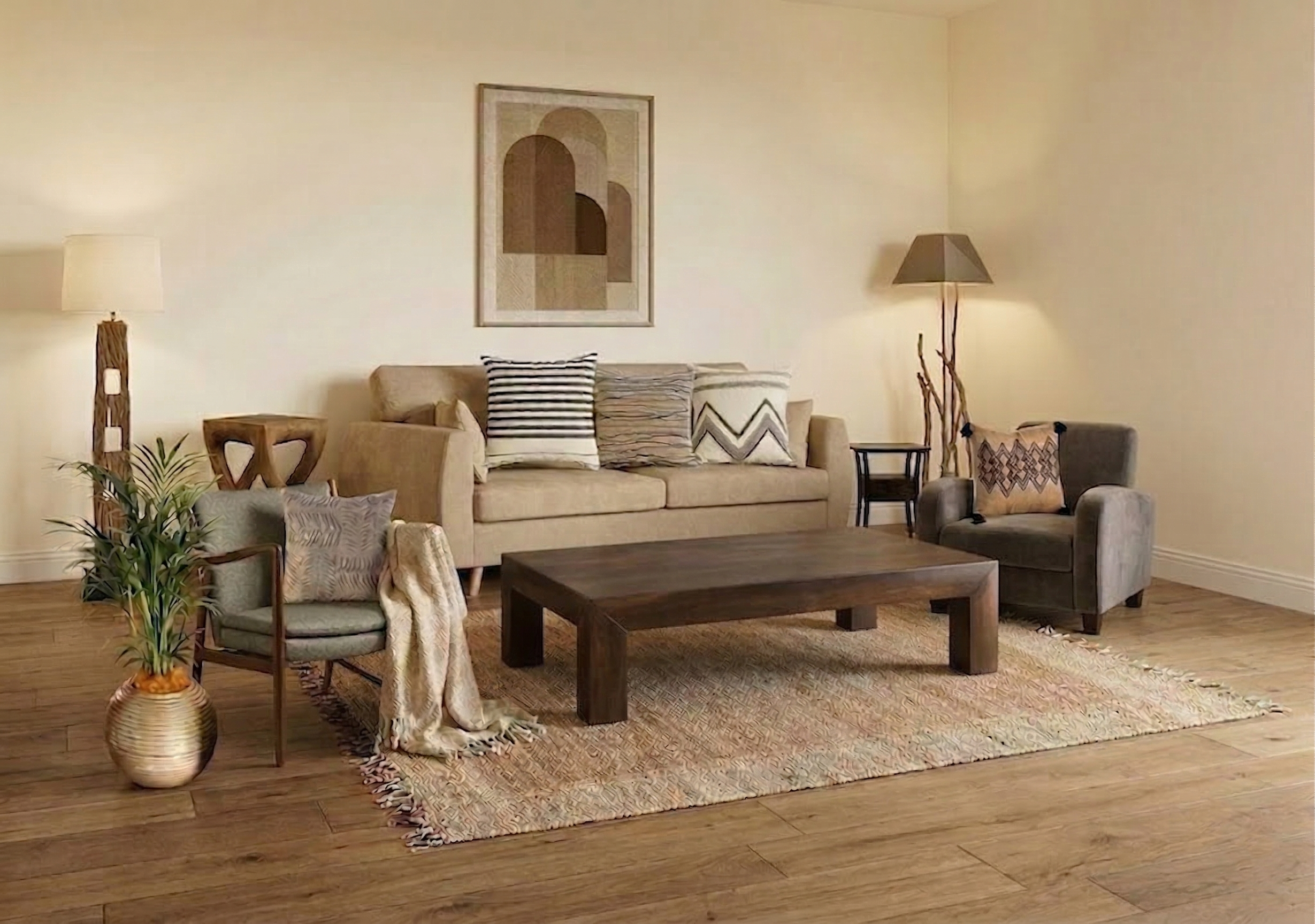
Once the moodboard felt right I used AI to generate a room render — just to see whether the concept actually held together as a lived space.
It was genuinely useful. Seeing it as a room told me things the moodboard could not. The scale felt right. The warmth landed. It looked like somewhere a real family could live rather than a showroom.
It also showed me where more work is needed. The artwork above the sofa is doing a lot of the mid-century reference work on its own and that language needs to continue through the rest of the home.
Why I am sharing this
This moodboard and render are not diploma submissions. They are just what happens when a concept gets under your skin and you want to see it through further than the brief requires.
Nordic Dock started as a scrapbook page — cinnamon sticks, a pine forest painting, jute rope, a piece of cork, a handwritten poem. It is now a room I can see.
That is the part of design I find most satisfying. The moment a feeling becomes a space.
This concept will change as I make progress towards my Diploma modules and so this design will change.
P.S. This was just my curiosity
Urvashi